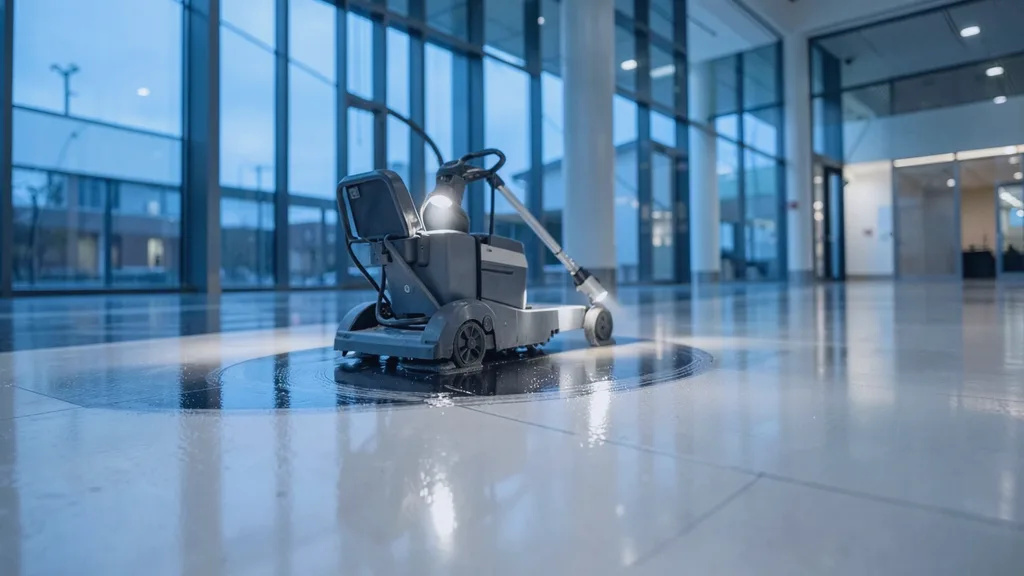
Ride-on rotary floor scrubber gliding in a slow arc across a glossy atrium floor

Safety Testing & Certification for Commercial Businesses

Safety Testing & Certification for Commercial Businesses in Bristol

Use this guide to define what commercial businesses need from safety testing & certification in Bristol, then review comparable responses from local providers.
Compare Quotes

Commercial Office & Facility Janitorial Quote

Professional commercial cleaning, night janitorial crews, and floor care for offices and facilities.

Step 1 of 8: Facility Type & Cleaning Frequency

Facility Type & Cleaning Frequency

Specify facility requirements, frequency of cleaning, and specialized janitorial services

What type of facility needs cleaning?
  • Define the safety testing & certification outcome and current site condition
  • Include access, occupancy, timing, and handover needs for commercial businesses
  • Compare inclusions, exclusions, proposed method, evidence, and price

safety testing & certification for commercial businesses

Safety Testing & Certification for Commercial Businesses in Bristol: what the work involves

Clinics, dental practices, veterinary surgeries and treatment rooms need cleaning that stands up to inspection, not just cleaning that looks tidy. Practices registered with the Care Quality Commission must keep premises and equipment clean and have regard to the Code of Practice on the prevention and control of infections, and an inspection can ask how cleaning is specified, carried out and checked. A cleaning company does not take on the practice's legal responsibility, but its work has to fit the practice's own infection control policies.

Safety Testing & Certification for commercial businesses in Bristol

Start by giving bidders the practice's infection prevention and control policy and a floor plan marked with clinical and non-clinical areas. Clinical rooms, decontamination rooms and patient toilets need a different approach from offices and staff rooms. Dental practices in England follow HTM 01-05 for decontamination, which also addresses the cleanliness of the clinical environment, and many practices decide that the dental team cleans surfaces and equipment in the treatment zone while contract cleaners handle floors, walls, sinks and non-clinical areas. Write that division down so nothing is missed or cleaned twice.

Colour coding is standard in UK healthcare cleaning: red for toilets and washrooms, blue for general areas, green for kitchens and yellow for isolation rooms, with cloths, mops and buckets kept separate. Ask which products and dilutions will be used, whether they are compatible with the practice's surfaces and equipment, and whether disposable cloths or laundered microfibre will be used. Mop heads should be laundered or discarded rather than rinsed and reused.

What the work usually involves

Waste and sharps need clear boundaries. Clinical and offensive waste from treatment areas is the practice's responsibility to segregate and consign correctly, and cleaners should not handle sharps containers or clinical waste bags unless that has been specifically agreed and trained for. The specification should say what cleaners do with each waste stream and what they must report, such as a sharp found on the floor or a spill of body fluids. Spill kits should be kept where cleaners can reach them.

Timing affects both hygiene and patients. Most practices want cleaning done after the last patient, with a check of toilets and waiting areas during the day if footfall is high. Agree how cleaners access rooms holding controlled drugs, patient records or X-ray equipment, and whether those rooms are locked during cleaning. Cleaning staff need infection control and COSHH training relevant to the setting, and should know what to do if they find a defect, such as a damaged floor, that stops a surface being cleaned effectively.

What to look for in a quote

Records are what an inspector sees. Ask for a cleaning schedule for each room, signed or electronic completion records, and regular audits of standards with a route for feeding results back to the practice manager. Some companies use ATP swab testing as an extra check on surface cleanliness; it can be useful, but it supports visual audits rather than replacing them. Keep the records together so they can be produced when asked.

Before choosing between the cleaning companies you are put in touch with, ask for examples of the audit forms they would use, how staff absence is covered without sending untrained cover, the training provided for healthcare settings, and how the specification will be reviewed if the practice adds rooms or changes its opening pattern. A short initial period with agreed audit scores gives both sides a clear starting point.

Before You Compare

Reduce gaps in the scope before providers price the work

Clear constraints and explicit exclusions reduce the chance of comparing prices built around different assumptions.
Surface the constraints
Start with what exists now, what needs to change, when the work is needed, and the operational requirements for commercial businesses. Attach dimensions or images that help explain it.
Align the inclusions
A lower total for safety testing & certification may cover less work. Ask providers to clarify exclusions, allowances, timing, and payment terms where their assumptions differ.
Request the relevant records
Request only evidence relevant to safety testing & certification: current credentials, suitable insurance, and the written testing, warranty, or handover records included in the quote.

Commercial Businesses safety testing & certification quote planning

Plan safety testing & certification around your requirements

Request written quotes for safety testing & certification in Bristol; review what each proposal actually includes before deciding whether to proceed.
Compare Quotes

Designed for Commercial Businesses

How safety testing & certification usually runs

Use the same audience-specific brief from first enquiry through comparison and final confirmation, so assumptions about safety testing & certification stay visible.
  • 1. Define the working brief

    Record the current condition, desired outcome, location, access, occupancy, timing, and site contact for commercial businesses.
  • 2. Compare written proposals

    Check each safety testing & certification quote for inclusions, exclusions, method, prerequisites, timing, price, and the evidence offered.
  • 3. Confirm before work starts

    If you choose a proposal, confirm the agreed scope, schedule, access plan, payment stages, and handover records directly with that provider.
Illustrative photography

Illustrative examples of relevant service categories

Use these illustrative category images as context when describing the work; they are not a local project portfolio.

Other Services for Commercial Businesses

Review the services available in Bristol and choose the guide that best matches the work commercial businesses need priced.

Services relevant to commercial businesses

Compare Safety Testing & Certification quotes for Commercial Businesses

Review written proposals against your brief for commercial businesses in Bristol and make an unhurried choice.
Step 1 of 8: Facility Type & Cleaning Frequency

Facility Type & Cleaning Frequency

Specify facility requirements, frequency of cleaning, and specialized janitorial services

What type of facility needs cleaning?